Drifting off temperature
A wine unit that slowly warms or won't hold its set point usually has a tired evaporator, a weak fan, or a control reading the wrong temperature — not a failed cabinet. We confirm the cause before quoting.
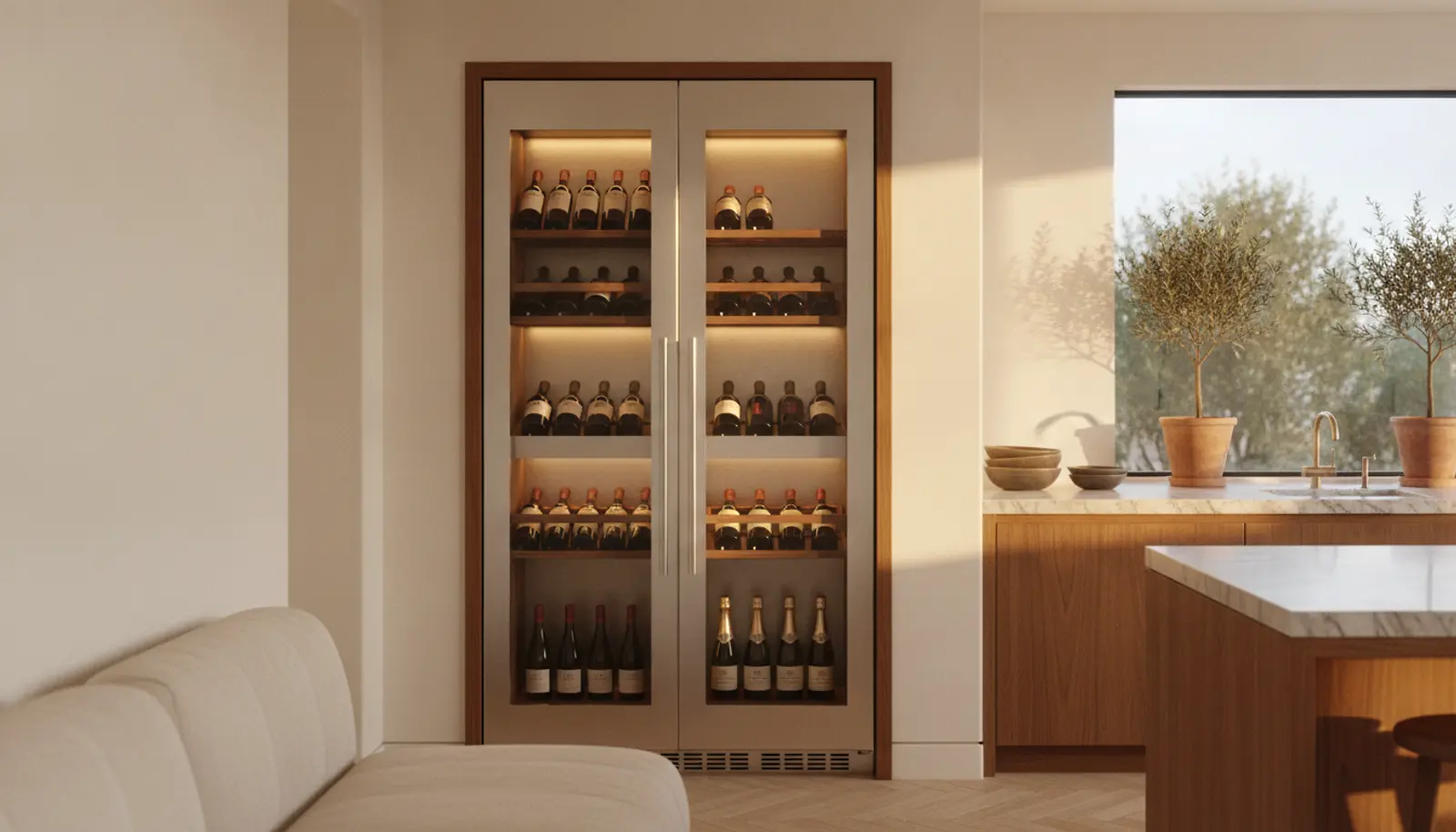
Sub-Zero Repair · Dual-Zone Wine Columns & Undercounter · Out-of-Warranty · Southern California
When a Sub-Zero wine unit drifts off temperature or starts icing the back wall, the usual causes are a tired evaporator or fan, a sensor reading the wrong temperature on one zone, or a door and UV-glass seal letting warm air in. Our techs at Zero Degree Built-In Refrigeration diagnose by zone first, so a targeted fix doesn't turn into a full-cabinet quote.
Mon–Sat 8am–8pm · Sun closed · Requests 24/7 online, phone & chat
The short version
Across the Southern California homes we work in, most Sub-Zero wine calls are about precision slipping rather than a unit dying outright: a slow drift off set point, one zone of a dual-zone cabinet running warm, a little frost at the back, a new hum in the cabinetry. The common causes are a tired evaporator or fan, a temperature sensor reading wrong, and a door or UV-glass seal letting warm air in. Fewer trace to the sealed system.
From La Jolla and Newport Beach to Brentwood, Westlake Village, and Santa Barbara, these units do quiet, demanding work — holding a tight temperature and steady humidity, year after year, often built into the cabinetry. That's why we diagnose by zone first: a single warm zone points to a targeted, affordable fix and leaves the healthy side untouched.
We read each zone, confirm what the control is actually sensing, and reach the sealed system only when everything upstream is ruled out — with an honest number before anyone commits.
What goes wrong
Wine storage fails quietly — a degree or two of drift, a little frost, a new hum. Across Southern California these are the patterns we see most, and each points somewhere specific.
A wine unit that slowly warms or won't hold its set point usually has a tired evaporator, a weak fan, or a control reading the wrong temperature — not a failed cabinet. We confirm the cause before quoting.
On dual-zone units the two halves are controlled separately. When only one zone drifts, the fault is almost always that zone's sensor, damper, or airflow — a targeted fix, not a whole-unit problem.
Frost or ice forming behind the bottles points to a defrost or airflow issue, or warm air sneaking past the door. Left alone it both wastes energy and risks the labels and corks.
Wine units rely on a tight gasket and UV-tinted glass to hold temperature and humidity. A worn seal shows up as condensation, drifting temperature, and a compressor that runs far too often.
New rattles or a hum that travels through the cabinetry can be a fan or mount — and vibration is something wine in particular doesn't tolerate. We track it down and protect the bottles while we work.
How we diagnose
Wine cabinets reward precision. We read each zone, confirm what the control is sensing, and work toward the sealed system only once everything upstream is ruled out.
On dual-zone units we check both halves independently, because a single warm zone narrows the diagnosis fast and keeps a healthy zone untouched.
A wine cabinet is only as accurate as its temperature sensing. We confirm the control is reading the real temperature before assuming the refrigeration is at fault.
Icing and warm spots usually live here. We read the airflow path and the defrost behavior rather than swapping parts and hoping the frost stays gone.
The seal and the glass door do real thermal work on these units. We check the gasket all the way around and the closing action before condemning anything electrical.
If the loss is the compressor or refrigerant, we say so plainly, recover refrigerant under EPA 608, and give you the repair-versus-replace math for that specific cabinet.

Models this hits
From the current dual-zone columns to the legacy 400-series wine cabinets — these are the lines we service, drawn from the model taxonomy we maintain.
Designer + Classic wine columns / undercounter; dual-zone, UV glass
Full-size & undercounter wine, dual-zone
Repair or replace
Replacing built-in or undercounter wine storage is expensive and disruptive — it's cabinetry, not a freestanding appliance. That tilts the math firmly toward repair for the common faults: a sensor, a fan, a gasket, a defrost issue on an otherwise sound cabinet.
The one place we slow down is a failed sealed system on a very old unit. There the cost climbs, and on the oldest cabinets replacement can be the smarter call. We give you that read straight, with the numbers for your specific model, so you decide with the full picture.
It's also worth weighing what the unit protects. A wine cabinet that's drifting isn't only an appliance problem — it's a risk to a collection that may be worth far more than the repair itself. Catching a failing sensor, fan, or seal early is almost always cheaper than the loss it quietly prevents, which is why a small drift is worth a call rather than a wait.
You pay fair, market-average rates: a Sub-Zero takes the same skilled work as any built-in, so you're not paying a premium for the badge.
Ranges are estimates by model and fault; the exact price is confirmed on-site, and you approve the work before we start. No flat fees, no surprises.
If you want the numbers first, our repair cost ranges are broken down by job.
Wine storage questions
A wine unit that won't hold temperature usually has one of a few causes: a tired evaporator or fan, a temperature sensor reading wrong, or a door and UV-glass seal letting warm air in. We confirm which one before quoting, because a sensor or a gasket and a sealed-system repair are very different jobs.
Because the two zones are controlled independently. When only one drifts off temperature, the fault is almost always in that zone — its sensor, its airflow, or its damper — rather than the whole refrigeration system. That's good news: it points to a targeted repair, and the healthy zone stays as it is.
Frost on the back wall points to a defrost or airflow problem, or warm, humid air getting in past a worn door seal. On a wine unit it's worth catching early — beyond the energy waste, icing and the humidity swings behind it are hard on labels and corks.
Yes. We service the legacy 400-series wine units such as the 424 and 427, the WS-30, and the current wine storage line including built-in and undercounter columns like the DEC3050W, 315W, CL2450W, and UW24. Many parts for these remain available and we carry genuine OEM components.
It's worth looking at. A new rattle or a hum carrying into the cabinetry is often a fan or a loose mount, and vibration is something stored wine genuinely doesn't tolerate well. We trace the source and resolve it rather than leaving the bottles to ride it out.
Usually worth repairing. These cabinets are built to last, and a sensor, fan, gasket, or defrost fix on a sound unit is far cheaper than replacing built-in wine storage. We get cautious only with a failed sealed system on a very old unit — and there our Sub-Zero specialists at Zero Degree Built-In Refrigeration will give you the honest math for your specific model rather than steer you toward a new cabinet.
It depends on the failure, so we quote ranges by symptom rather than a flat fee. You pay fair, market-average rates: a Sub-Zero takes the same skilled work as any built-in, so you're not paying a premium for the badge. A sensor or a gasket sits at one end of the scale and a sealed-system repair at the other, and you'll know which before any work starts.
Common symptoms
Keep exploring
Mon–Sat 8am–8pm · Sun closed · Requests 24/7 online, phone & chat